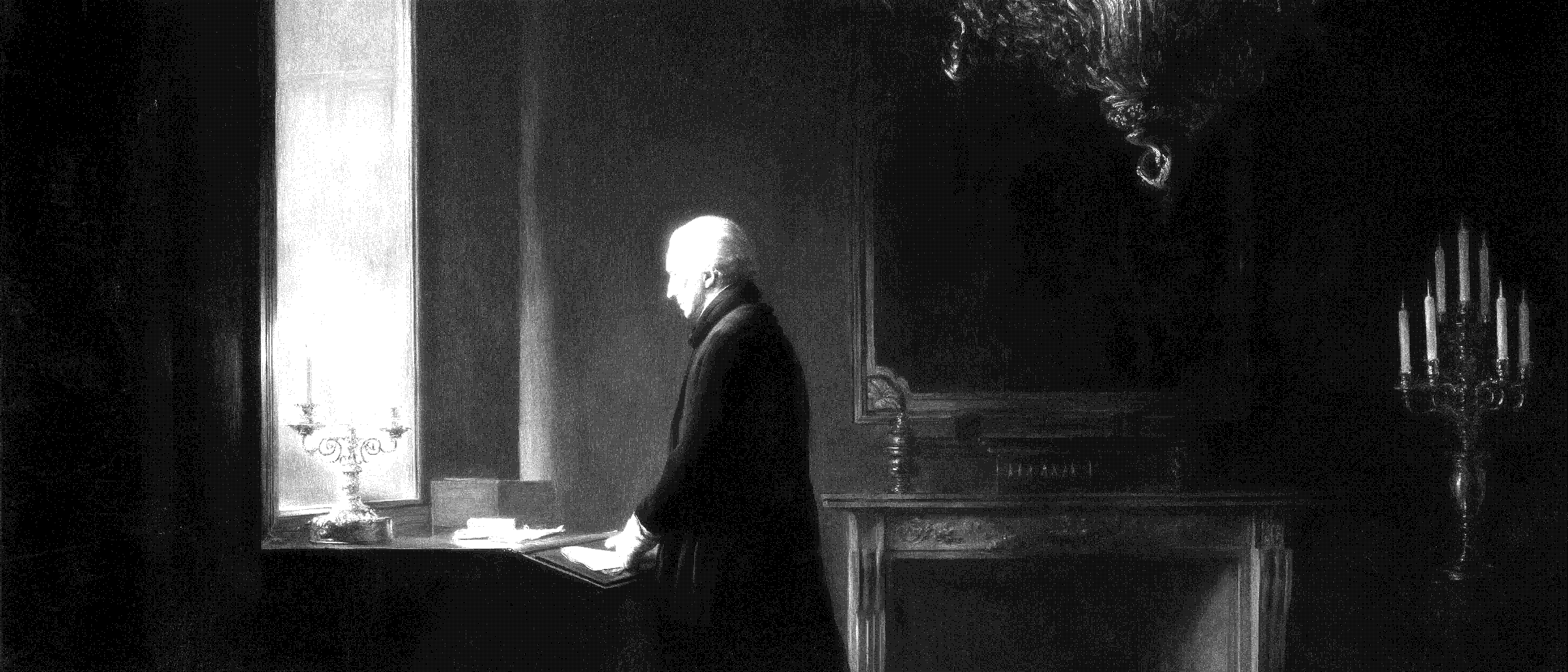
Franconian Circle, November 1793
Count Albrecht von Thürnau sat alone in the library of Schloss Thürnau, though sat is insufficient — he inhabited the chair as a shell inhabits its spiral, long after the creature has gone. The room was cold. The servants had been dismissed at seven, as they were every evening, and the fire had burned down to the white-blue ghosts of beech logs arranged just so on the andirons.
He was seventy-two. His wife, Elisabeth, had been dead fourteen years. His son, Friedrich, was with the Kaiserlich-Königliche Armee at the Rhine, where the French Republic had been pushing east all autumn. The last letter had come in September, written in a hand so steady it must have been forced: We hold the line, Father. Do not worry. Albrecht had read it seven times, folded it, placed it in the silver box beside Elisabeth's pearl rosary.
He did not worry. Worry was for men who still believed their agency could alter events. He had passed through that gate long ago.
The chandelier held six candles. He had lit three.
This was not miserliness. It was an act of precision, of fitting the light to the room's need rather than to the room's capacity. All his life, Albrecht had resisted the temptation of abundance — of wine that exceeded thirst, of words that exceeded meaning, of torches that turned a hallway into a stage. Elisabeth had understood this. You light a room, she once said, the way you say a prayer: enough to be present, not enough to be seen.
He missed her grammar. She had spoken German the way a mason lays stone — each word placed, then left alone to bear weight.
A knock.
Albrecht did not turn. "Enter."
The door opened. It was not a servant. It was the parish priest, Father Matthias, who had walked three miles through the November dark to deliver news he had clearly been carrying since noon. The priest's cassock was wet at the hem; his face was the face of a man who has rehearsed a sentence so many times it has lost all meaning and regained it as dread.
"Your Grace."
Albrecht looked at him. Then he looked at the letter in the priest's hand — a military dispatch, folded and sealed with the double-headed eagle.
"Would you like to sit first?" Albrecht said. "You have mud on your boots."
The priest sat. The letter was placed on the writing desk, between the silver inkstand and the small framed portrait of a woman who had died with a smile on her face, having received the Last Rites and having whispered, Tell Albrecht I am not afraid.
Albrecht did not open the letter immediately.
He poured two glasses of wine from the decanter that had stood untouched on the sideboard for three months. He handed one to Father Matthias. The priest accepted it without the usual protest — a man who would ordinarily refuse wine on a pastoral call, because it blurred the boundary between comforter and companion, did not refuse it now.
"You walked from St. Emmeran's," Albrecht said. Not a question.
"Yes."
"The messenger came to you first, not to the castle."
"He did. He arrived at the rectory at four. He was... young. Prussian. He did not know how to deliver the news he carried. I told him I would bring it myself."
Albrecht nodded. This was right. A boy in a uniform, clutching a folded paper, standing in the courtyard of a schloss he had never heard of, trying to tell a count that his son was dead — no. Better that the truth travel through hands that had learned to hold it without dropping it.
He opened the letter.
It was a form, mostly. We regret to inform you. The script was neat, administrative, the handwriting of a clerk in a rear office who had written the same sentence nineteen times that afternoon. Fought with valor. Fell at the Battle of Wörth. His remains were not recoverable.
Albrecht read it twice. Then he folded it along its original creases and placed it back in the envelope.
"The Battle of Wörth," he said. "That was October. He has been dead a month."
"Yes."
"They did not send word sooner."
"That is how it is done, Your Grace. They wait until they have a full accounting. They do not send one letter at a time."
Albrecht nodded again. He understood. He had commanded men once, in the service of the Prince-Bishop of Würzburg. He knew that war is not a tragedy that unfolds in sequence but a collapse that is reported in fragments. The delay was not negligence. It was the machinery of empire — slow, thorough, indifferent to the weight of each individual cog.
"The body," Albrecht said. "They said his remains were not recoverable."
"Yes."
"That means an artillery strike. A direct hit. Or he was behind French lines and the retreat did not allow retrieval."
"Your Grace, you do not have to—"
"I am not in pain, Father. I am describing what happened. There is a difference between suffering and narrating. I have done the first. Now I am doing the second."
He stood and walked to the window. The glass was cold. Beyond it, the hills of Franconia lay black under a moonless sky. Somewhere out there, in that darkness, a young man who had learned to ride a horse in this courtyard, who had wept when his mother died and then never wept again, who had written letters in steady hand to his father because that was what von Thürnau men did — somewhere out there, that young man had been torn apart by iron and gunpowder, and his body had been left in mud that would freeze by morning, and the French would bury what they found in a pit without a marker.
His remains were not recoverable.
Albrecht pressed his palm flat against the cold glass.
"There is no grave," he said quietly.
Father Matthias stood and came to stand beside him. "There is a grave, Your Grace. In the heart of God."
Albrecht turned and looked at the priest. Not with anger. With the particular stillness of a man who had spent seventy-two years learning to distinguish comfort from falsehood — and had developed an exact ear for the difference.
"Father. You believe that. I know you do. And I believe it as well, in the part of me that belongs to the Church and not to the world. But the part of me that belongs to the world wants a patch of earth with his name on it. A patch of earth I can walk to. A patch of earth I can kneel on."
"Yes."
"That is not an unreasonable thing to want."
"No, Your Grace. It is the most reasonable thing in the world."
They stood in silence for a long time. The fire settled. The candles burned lower.
Albrecht thought about Elisabeth — about how she had said, on her deathbed, I am not afraid. He had not understood, then. He had been fifty-eight years old and had never lost a child. He had thought he knew what loss meant because he had held his wife's hand while she died, and that had been the worst day of his life. But he now understood that there were sorrows that did not compete, did not rank themselves, did not allow you to say this one is harder than that one. They simply accumulated. They layered. They became the geography of a man's interior, and he learned to walk across them the way a mountaineer learns to walk across scree — one careful step at a time, never trusting the ground to hold.
"Father."
"Yes."
"I will not offer you a bed tonight. I know you must return to the parish. But I am grateful that you walked here. Grateful that you did not send a servant. Grateful that you understood what the news required."
"Your Grace, I would not have sent anyone else."
"I know."
Father Matthias left. Albrecht heard his boots on the gravel of the courtyard, then the crunch of frost on the road, then nothing.
He returned to the chair. He finished the wine. He looked at the portrait of his wife, and at the silver box that held her rosary and his son's last letter.
The line of von Thürnau would end with him. There were cousins, distant branches, but the title would dissolve or be absorbed. The castle would pass to the ecclesiastical see. The name would become a footnote in the registers of the Franconian Circle — a name that had once meant something, had once been spoken with respect in the courts of Würzburg and Bamberg, had once been written in the margins of treaties and the dedications of altarpieces.
And this, too, was bearable.
Because a name was not a soul. A line was not a salvation. Friedrich was with God — or, if God did not exist, which Albrecht sometimes doubted in the dark hours before dawn, then Friedrich was simply gone, and the absence was the same either way. But if there was a God — and Albrecht had spent his life acting as though there was, which was perhaps the same as believing — then Friedrich was with Elisabeth, and they were waiting, and the time between now and then was the only thing that remained.
He reached for the silver box. He opened it. He took out the letter — September, steady hand, We hold the line, Father — and read it once more.
Then he took out Elisabeth's rosary. The beads were mother-of-pearl, worn smooth by decades of fingers that had known when to hold and when to release.
He knelt.
The floor was cold. The room was dark. The Count of Thürnau, last of his line, began to pray.
Ave Maria, gratia plena, Dominus tecum.
Benedicta tu in mulieribus, et benedictus fructus ventris tui, Iesus.
Sancta Maria, Mater Dei, ora pro nobis peccatoribus, nunc et in hora mortis nostrae.
Amen.
Three candles burned in a room too large for them. A father knelt on cold stone. The Holy Roman Empire was dying all around him — its borders crumbling, its armies retreating, its certainties dissolving into the fog of a century that had lost faith in thrones and altars alike. And yet, in that library, in that hour, something held.
Not power. Not legacy. Something smaller and more durable.
A man, on his knees, refusing to let the dark have the last word.